
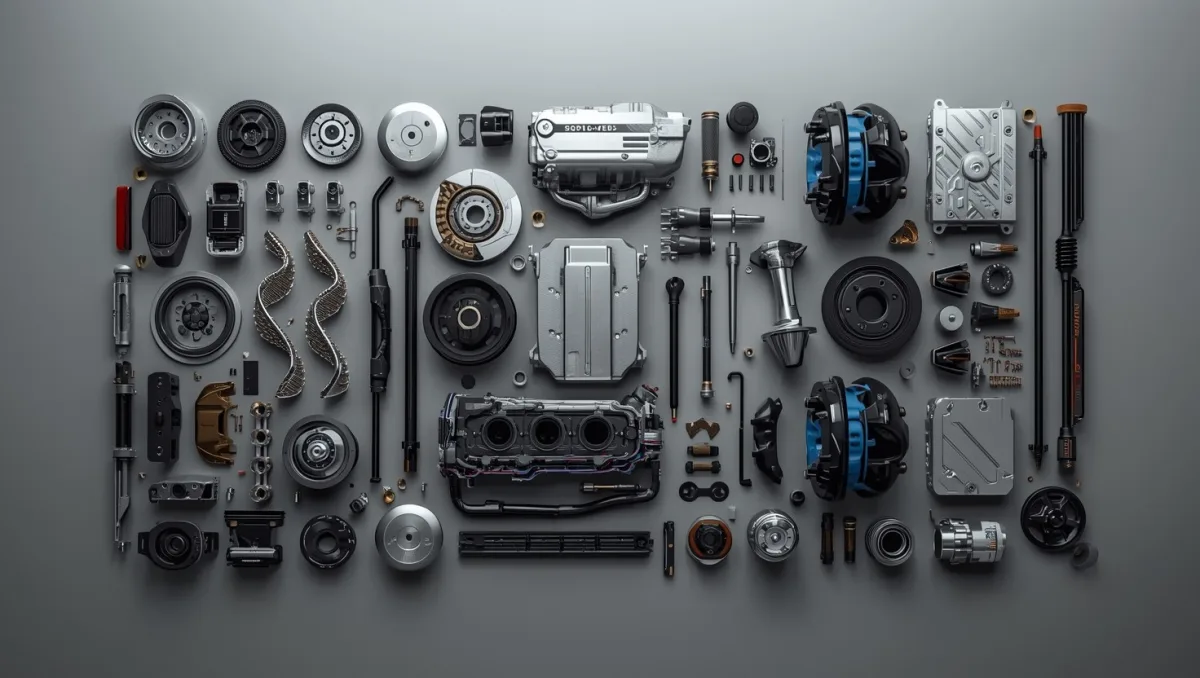
OEM sourcing teams face a collision of forces: geopolitical tariff shifts, EV transition demands, semiconductor allocation constraints, and rising freight volatility. Choosing the right country to source a given component is no longer a simple cost calculation. It is a strategic decision that shapes product quality, time to market, and long term supply resilience. This guide ranks the leading sourcing countries for automotive components, breaks down the trade offs, and gives procurement professionals a practical playbook for 2026 and beyond.
Global Parts Trade
The global automotive parts market was valued at approximately USD 2.15 trillion in 2024, according to Grand View Research, and is projected to grow at a compound annual growth rate near 3.5 percent through 2030. Cross border trade in automotive components continues to intensify as OEMs diversify supplier bases away from single country dependency. Six countries dominate global automotive parts exports: China, Germany, Japan, the United States, South Korea, and Mexico.
These figures reflect ITC Trade Map and national customs data. The ranking underscores why procurement teams must evaluate each of these countries carefully, understanding that raw export volume alone does not capture quality, specialization, or total landed cost.
Sourcing Criteria
The country rankings below weigh six core criteria that matter most to professional buyers and OEM sourcing organizations.
- Manufacturing capability and scale: Installed capacity, automation levels, tooling sophistication, and workforce skills.
- Labor and production costs: Average hourly manufacturing wages and overhead benchmarked against output quality.
- Quality and certification prevalence: IATF 16949 certification density, defect rates, and traceability infrastructure.
- Supplier ecosystem depth: Availability of Tier 1, Tier 2, and sub tier suppliers, raw material access, and clustering effects.
- Trade policy and tariff environment: Free trade agreements, current and anticipated tariff schedules, and regulatory alignment.
- Logistics and market proximity: Transit times to major OEM assembly hubs, port infrastructure, and freight cost stability.
Data sources include the OICA, ITC Trade Map, World Bank Doing Business indicators, IATF certification registries, and published industry analyses from McKinsey, Roland Berger, and the Automotive News supplier surveys. All data reflects conditions as of early 2025 with forward looking adjustments noted where applicable.
Top Countries
Germany
Precision engineering leadership. Dominant in powertrain systems, electronic controls, advanced driver assistance modules, and high tolerance machined parts. Extensive R&D and prototype capability.
Japan
Lean manufacturing pioneer. Strengths in transmissions, bearings, sensors, electrical systems, and high reliability components. Deep Tier 2 and Tier 3 supplier networks.
South Korea
Battery technology powerhouse with strong capabilities in electronics, infotainment, and stamped body components. Competitive costs relative to Japan and Germany for comparable quality.
China
Unmatched scale and breadth. Competitive across castings, forgings, rubber and plastic parts, wiring harnesses, EV battery cells, and increasingly in electronic control units. Cost advantages remain significant for volume orders.
Mexico
Nearshoring gateway for North American OEMs. Strengths in wire harnesses, stamping, interior trim, and brake systems. USMCA trade benefits and short transit times to US assembly plants.
India
Rapidly growing supplier base with cost advantages in forged and machined components, fasteners, rubber parts, and two wheeler components. Government incentives under the PLI scheme are expanding capacity for EV parts.
Country Profiles
Germany
Germany hosts over 2,000 IATF 16949 certified automotive supplier sites. Stuttgart, Munich, and Wolfsburg form the core of Europe's densest automotive supplier clusters. Tier 1 giants like Bosch, Continental, and ZF anchor an ecosystem that extends to hundreds of specialized Mittelstand firms producing everything from precision gears to advanced sensor housings. R&D spending in the German automotive sector exceeded EUR 28 billion in 2023, according to the VDA. The trade off: German components carry premium pricing, and lead times for custom tooling can be longer than Asian alternatives.
Japan
Japan's automotive supplier ecosystem is tightly integrated with OEMs like Toyota, Honda, and Nissan through keiretsu relationships. Aichi Prefecture alone accounts for a massive concentration of parts production. Japanese suppliers are known for exceptionally low defect rates, often measured in single digit parts per million. Key specializations include CVT and automatic transmission components, ceramic and electronic sensors, and high strength steel stampings. Cost levels sit between Germany and China.
South Korea
Anchored by Hyundai-Kia's supply chain, South Korea excels in EV battery components (with LG Energy Solution, Samsung SDI, and SK On), advanced displays, and premium interior materials. The Ulsan industrial region is one of the world's largest single site automotive manufacturing zones. Korean suppliers increasingly compete for European and North American OEM contracts outside the Hyundai-Kia orbit.
China
China produced over 30 million vehicles in 2023, making it the world's largest auto market by volume. Its supplier base spans every component category. Key clusters include the Yangtze River Delta (Shanghai, Jiangsu, Zhejiang), the Pearl River Delta (Guangdong), and the Bohai Rim (Beijing, Tianjin, Liaoning). China's EV supply chain is arguably the most vertically integrated in the world, from lithium refining through cell production to motor assembly. Quality has improved markedly over the past decade, though buyers should still conduct rigorous qualification for safety critical parts.
Mexico
Mexico is the sixth largest vehicle producer globally, assembling over 3.9 million units in 2023. Nuevo León, Guanajuato, Puebla, and Coahuila are major production states. The country's USMCA qualifying supplier base has expanded rapidly, and transit times to Detroit or the US Southeast are typically two to four days by truck. Wire harness production is a particular strength, with firms like Aptiv, Yazaki, and Lear operating large facilities. Labor costs are competitive at roughly one fifth of US levels for manufacturing workers.
India
India's automotive component exports reached approximately USD 20.1 billion in fiscal year 2024, according to ACMA. Chennai, Pune, and the National Capital Region are the primary clusters. India dominates global supply of forged and machined engine parts, fasteners, and certain rubber components. The government's Production Linked Incentive scheme is channeling investment into advanced chemistry cells, EV drivetrain parts, and electronics. Quality certifications are expanding but remain less uniformly distributed than in Germany or Japan, making on site supplier audits essential.
Cost and Quality
The central tension in automotive sourcing is balancing unit cost against quality assurance and capability requirements. Not every component demands a German or Japanese pedigree, and not every high volume part should be sourced purely on lowest cost.
Labor cost alone does not determine total component cost, but it is a significant driver. For high volume, lower complexity parts such as rubber grommets, plastic clips, basic stampings, and standard fasteners, sourcing from China or India often delivers 30 to 50 percent savings with acceptable quality when suppliers hold IATF 16949 certification. For safety critical or precision components such as fuel injectors, ABS sensors, airbag inflators, and transmission gears, buyers should prioritize Germany, Japan, or South Korea, where process controls, traceability, and defect rates meet the most stringent OEM requirements.
Middle ground components like brake rotors, suspension arms, or interior trim can often be sourced from Mexico or established Chinese Tier 1 suppliers with strong quality track records, offering a balance of cost and reliability.
Logistics and Tariffs
Total landed cost is the metric that matters, not ex works price. A component that costs 20 percent less at the factory gate but requires six weeks of ocean freight, import duties, and customs clearance may end up more expensive than a nearshore alternative.
For North American OEMs, Mexico offers the strongest logistics proposition: truck transit of two to four days, USMCA preferential tariff treatment, and expanding rail infrastructure connecting Monterrey and Bajío to the US Midwest. Current US tariff policy imposes significant duties on Chinese automotive parts, making total landed costs from China materially higher than the factory price suggests.
For European OEMs, Central and Eastern European countries such as Czechia, Poland, and Romania provide nearshore alternatives with EU single market access and transit times under a week. Turkey is another important option with a customs union agreement covering automotive goods.
Free trade agreements significantly affect sourcing economics. The EU-Japan Economic Partnership Agreement, EU-South Korea FTA, and CPTPP all reduce or eliminate duties on qualifying automotive parts. Procurement teams should map applicable trade agreements before finalizing country selection.
Practical Checklist
- Define component criticality tier: Classify each part as safety critical, functional, or commodity. This determines minimum supplier capability requirements.
- Verify certifications: Require IATF 16949 as baseline. For electronics, confirm ISO 26262 functional safety compliance. For EV battery components, confirm UN38.3 testing.
- Calculate total landed cost: Include unit price, tooling amortization, freight, duties, customs brokerage, currency hedging, and inventory carrying cost.
- Assess supply chain resilience: Identify single points of failure. For high volume or critical parts, qualify at least two suppliers in different countries or regions.
- Conduct on site audits: Virtual audits are a starting point, but physical facility visits remain essential for first time supplier qualification. Evaluate process controls, raw material traceability, and workforce training.
- Review geopolitical and tariff risk: Monitor trade policy developments quarterly. Build tariff scenario models into sourcing decisions.
- Negotiate contract terms carefully: Include clear quality KPIs with financial consequences, guaranteed capacity allocation, raw material cost pass through mechanisms, and force majeure definitions updated for pandemic and geopolitical scenarios.
- Test logistics reliability: Run trial shipments before committing volume. Measure actual versus quoted transit times and damage rates.
- Leverage supplier directories: Use verified platforms to discover and compare automotive component suppliers across regions, reducing early stage qualification time.
Risk Mitigation
The semiconductor shortage of 2021 to 2023 and pandemic era logistics disruptions permanently changed how OEMs think about supply risk. Single source strategies are increasingly unacceptable for any component that could halt a production line.
A practical dual sourcing framework starts by pairing a primary supplier in one region with a qualified alternate in a geographically distinct region. For example, pair a Tier 1 stamping supplier in Germany with a qualified Tier 1 in Mexico or South Korea. Maintain active purchase orders with both, even if the split is 70/30, to keep the secondary supplier engaged and production ready.
For emerging EV components such as battery enclosures, motor laminations, and power electronics housings, consider qualifying one supplier in China or South Korea (where EV supply chains are most mature) alongside a developing nearshore option. This provides cost competitiveness today while building optionality for tomorrow.
Supplier Discovery
Efficient supplier discovery is the starting point of any sourcing initiative. Modern procurement teams combine traditional industry contacts with digital supplier directories that offer verified company profiles, facility videos, certification documentation, and product catalogs. These platforms allow buyers to shortlist potential auto parts manufacturers across multiple countries before committing resources to on site evaluation.
When using supplier directories, prioritize profiles that include video walkthroughs of manufacturing facilities, independently verified quality certifications, clearly stated production capacities, and documented export experience to your target market. This level of transparency significantly reduces the risk of wasted audit trips and accelerates the qualification cycle.
Global sourcing research should also include engagement with industry trade shows (Automechanika, AAPEX, CTI Symposium), OEM supplier portals, and regional automotive industry associations such as ACMA in India, AMIA in Mexico, and the VDA in Germany.
There is no single best country to source automotive components. The right answer depends on what you are buying, how much you need, where your assembly plants are located, and how much risk your organization can absorb. Germany and Japan remain the gold standard for precision and reliability. China and India offer compelling economics for high volume, lower complexity parts. Mexico is the clear nearshoring leader for North American OEMs. South Korea is indispensable for EV battery technology and advanced electronics.
The most effective procurement strategies in 2026 will treat country selection as a portfolio decision. Spread sourcing across regions to balance cost, quality, speed, and resilience. Invest in rigorous supplier qualification regardless of geography. And continuously monitor the tariff and trade policy landscape, because the rules of global automotive sourcing are shifting faster than they have in a generation.